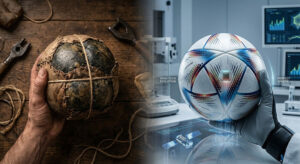
The Early Soccer Balls History mirrors the history of football itself. As the game evolved from chaotic village contests into a global sport governed by strict rules, the ball evolved too. Each improvement in ball design came from real problems players faced—poor control, dangerous weight, unpredictable bounce, and unfair advantages. Understanding the history of the soccer ball helps us understand why modern football looks and feels the way it does today.

It isn’t just about sports equipment; it is a mirror of human industrial evolution. From the raw, bloody organs of animals to the high-tech laboratories of the 21st century, this is the deep-dive story of how we invented the heart of the beautiful game.
When we watch a soccer match today, it’s easy to focus on speed, tactics, and skill. But rarely do we stop to think about the one object that connects every era of the game—the soccer ball. The ball is not just equipment; it’s the heart of football. Every pass, shot, and goal depends on how that ball behaves.

If you hold a modern soccer ball in your hands today, you are holding a miracle of engineering. It is thermally bonded, perfectly spherical, hydrophobic (water-repellent), and contains a microchip that communicates with satellites. But the road to this perfection was paved with bruised feet, bloody foreheads, and tragedy.
This object, which billions call “the ball,” has undergone a revolution more dramatic than almost any other piece of sporting equipment. It has decided World Cup finals, changed how the game is played, and even become a global cultural icon.

Let’s travel back in time to understand Soccer Ball History in its rawest, most authentic form.
As the most recognizable object in the world’s most popular sport, the soccer ball has undergone a fantastic evolution from its rudimentary form. From lumpy, hand-stitched spheres to the precision-made orbs of modern professional matches, the history of the soccer ball is a testament to human ingenuity and the advancement of technology. In this article, we will delve into the history of the soccer ball in greater detail, from its origins to its evolution into the high-performance standard we know today. As we proceed, we’ll also examine the cultural and historical context of the game, the materials involved, and the key innovations that led to the modern soccer ball.
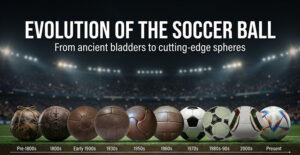
No single person “invented” soccer. Instead, football developed gradually across centuries and cultures. Ancient China played Cuju, a foot-based ball game using stuffed leather balls. The Greeks and Romans had their own versions, which were often played for training or entertainment.
However, the modern game began taking shape in England during the 18th and early 19th centuries. Early football had almost no rules. Villages played against villages, sometimes with hundreds of players chasing a ball across open land. In these first years of football, the ball itself varied wildly—sometimes round, sometimes oval, sometimes barely inflated.
This lack of consistency made the game both exciting and dangerous. Players never knew how the ball would bounce, how heavy it would feel, or whether it would even survive the match.

As you know, the history of the soccer ball dates back to the early 19th century, although its exact origin is lost in history. Long before standardized balls were invented, the cartridges of early iterations of the game were equipped with whatever form of matter was at hand. Games involving balls were played in ancient civilizations in China, Greece, and Rome, but they were not necessarily ball-shaped, at least not in the modern spherical sense. Early balls were often made from inflated animal bladders, stitched animal hide, or even tightly wound rags.

The first important step toward a more recognizable soccer ball came in the 1850s when a cobbler named William Deakin. With his own experience in the craft, Deakin had become fed up with the irregular and unreliable balls available to him in London. Early balls—inflated pig or cow bladders—were susceptible to bursting and tended to come in crazy shapes. Deakin conceived of a ball that was rounder, more durable, and more fitting for the beautiful game he loved.

William Deakin’s homemade soccer ball was a revolutionary invention. Drawing on his leatherworking skills, Deakin fashioned a ball using leftover leather pieces, the same material he used to create shoes. He sewed a few leather pieces by hand, creating a crude, near-spherical shape. He added vulcanized rubber, a newly invented material known for its elasticity and strength, to make the ball perform better and last longer. The resulting inflatable rubber core, which provided buoyancy when inflated, was a marked improvement over the earlier use of fragile animal bladders.

The ball of Deakin was far from perfect. It was lumpy and patchy, like a misshapen potato more than a contemporary soccer ball. But it was a giant leap forward. As the ball was first tested during a casual game in a London park, local boys were impressed by its consistency and bounce compared to the bladder balls they had used previously.

By the 1850s, however, the conditions for creating a soccer ball were less than ideal. Deakin operated in a small workshop with essential tools and materials. Leather was costly and typically recycled from old shoes and harnesses. Vulcanised rubber was a revolutionary development, but it was still relatively new and not widely available. The labour-intensive process of stitching together leather pieces by hand depended upon tremendous skill. Through all of this, Deakin’s commitment to making the game better resulted in a ball that was more reliable and more enjoyable to use.
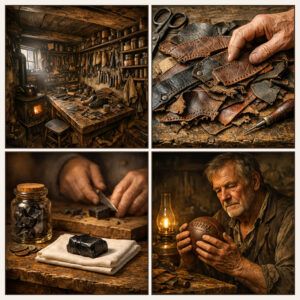
Exact records regarding the price of Deakin’s ball aren’t available, but early soccer balls were expensive due to the materials used to make them and the labor involved. Leather and vulcanized rubber weren’t inexpensive, and the handmade nature of the ball made it a luxury item. By way of comparison, a pair of leather shoes in the mid-19th century would run several shillings each, and a soccer ball would have been similarly priced, if not more so.
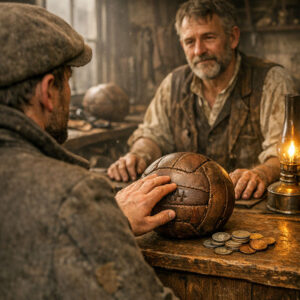
In the early 19th century, football was unrecognizable as the organized sport we have today. Matches were chaotic affairs, with little in the way of rules and often hundreds of players on each side. The game was played on open fields, and the objectives varied greatly from region to region. Irregular-shaped balls of different sizes rendered the game unpredictable, and physical exercise was required.
Deakin’s ball was not perfect, but it was a turning point. It enabled more controlled kicks and passes, making the game more orderly. Standardized rules and equipment only emerged later, with the formation of the Football Association (FA) in England in the late 19th century. During this time, the sport also adopted vulcanized rubber bladders wrapped in leather, which became the standard for soccer balls.
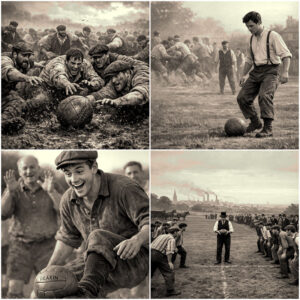
Long before organized rules, the FIFA World Cup, or multimillion-dollar contracts, humans had a primal urge to kick something. The earliest “disposable balls” were also available. But for thousands of years, the “ball” was often a gruesome object.
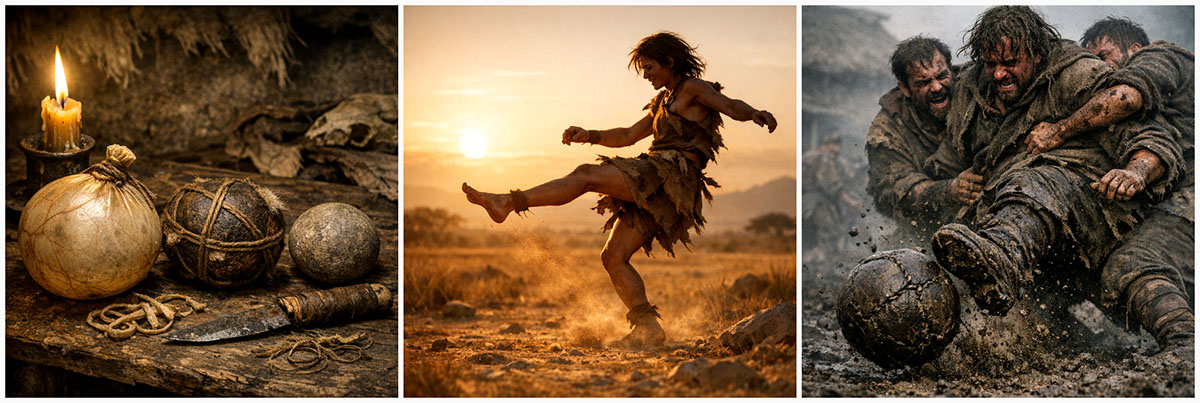
The Grim Tools of Ancient Games: Historical accounts and folklore paint a vivid picture. In ancient China, during the Han Dynasty (206 BC – 220 AD), soldiers played Cuju (“kick ball”) with balls made of leather stuffed with feathers or hair—a relatively advanced design. In contrast, pre-medieval European “folk football” was a violent, boundary-less melee between villages. The “ball” could be a captive’s head, a stolen animal bladder, or a rounded stone. One brutal legend describes villages using the skull of a defeated enemy or a slaughtered cow as the object to be kicked across a field. The goal was less about scoring and more about getting a gruesome trophy to a designated point, often a church or village square. These games were less sport and more ritualized chaos, where the ball’s behavior was as unpredictable as the game itself.

The Pig’s Bladder: A Revolutionary (Yet Disgusting) Leap: The single greatest prehistoric innovation came from the autumn harvest: the pig’s bladder. When communities slaughtered livestock for winter, the inflatable bladder was salvaged. Once cleaned and inflated by lung power—a task that could cause long-term health issues—it created a lighter, bouncier object than a skull or stone. For the first time, people could influence the ball’s firmness. Soon, craftsmen began sewing rudimentary leather casings around the bladder to help it retain a more spherical shape and last longer. This leather-covered bladder is the direct, if ungainly, ancestor of every modern ball.

The Core Problem: Unpredictability as the Norm: Despite this advance, the game was at the mercy of biology. No two pig bladders were alike. They were inherently lumpy, oval, and erratic. A kick could send the ball skidding, bouncing, or veering off at a random angle. There was no standard weight, size, or bounce. The game was one of constant adaptation to the ball’s whims, making skill as much about luck and brute force as about technique. This era was defined by the fundamental question: “How do we make this thing behave consistently?”

When we examine the early history of soccer balls, we don’t see uniformity. We are seeing survival of the fittest.
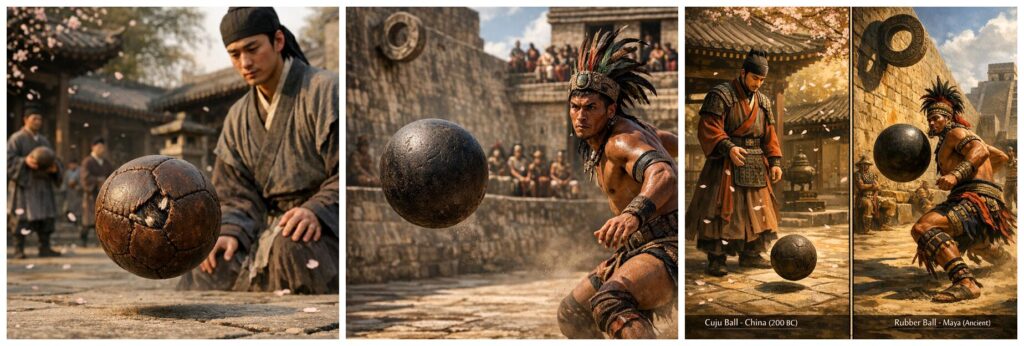
China (Han Dynasty): Around 200 BC, the game of Cuju utilized a ball made of sewn leather skins. But inside? It wasn’t air. It was stuffed tightly with feathers and hair. This made the ball incredibly heavy and “dead”—it didn’t bounce; it just thudded.
The Mayan Rubber Sphere: In Mesoamerica, civilizations were actually ahead of their European counterparts. They used latex from rubber trees to create solid rubber balls for their ceremonial games. These were bouncy but lethal. Being hit in the stomach by a solid, 4kg rubber ball could cause internal bleeding.
In Medieval Europe, if you wanted to play “mob football,” you visited the butcher, not the sports store. The most common solution for a lightweight, bouncy object was an inflated pig’s bladder.
The bladder was surprisingly effective because it was naturally semi-elastic. However, organic tissue has a major flaw: it rots. It is also rarely rounded; it’s lopsided. To make these bladders last longer and maintain a better shape, people began wrapping them in leather. This was the birth of the “leather casing,” but the ball was only as good as the organ inside it. If the pig had an oddly shaped bladder, you had an oddly shaped ball.
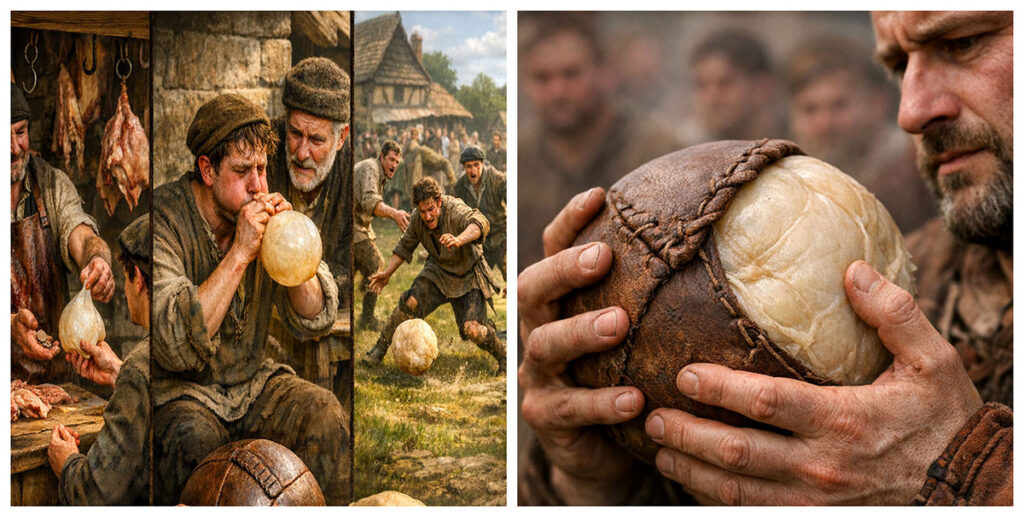
The earliest soccer balls were extremely basic. As mentioned above, most were made from animal bladders, especially pig bladders, inflated by mouth. These bladders were fragile and easily punctured, so players often wrapped them in leather for protection.
These early balls had major flaws. They were uneven, difficult to control, and painful to the head. On cold days, the leather stiffened. On wet days, it absorbed moisture and became heavier. Despite this, players adapted their style, focusing more on ground play than aerial passes.
In many ways, early soccer demanded toughness more than technique.
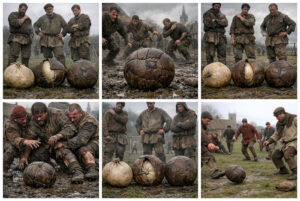
The 1800s marked the beginning of organized football. Clubs formed, matches were scheduled, and competition became serious. With this shift came a growing demand for better equipment.
The early soccer ball sizes and masses were inconsistent. One club might use a relatively light ball, while another might use a heavy one. This caused disputes, especially during competitive matches. There was also no agreement on circumference or internal pressure.
Players began to realize that the quality of the ball directly affected their performance. Passing accuracy, shooting power, and player safety all depended on better design.
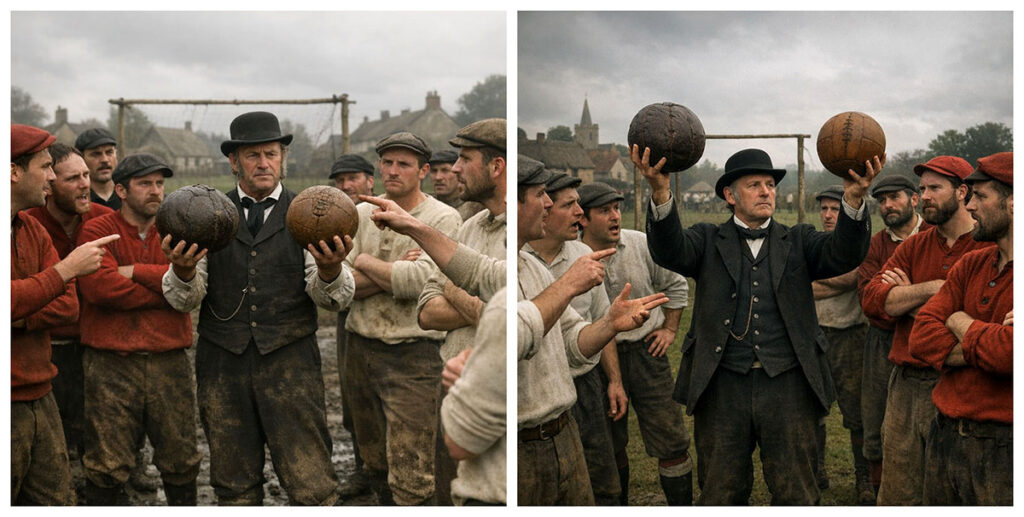
First Major Breakthrough
The 19th century brought science and industry to bear on this problem of chaos, transforming the ball from a natural byproduct into a manufactured product.
One of the most important moments in soccer ball history was the discovery of vulcanization by Charles Goodyear. Vulcanization strengthened rubber, making it elastic, durable, and resistant to temperature changes.
This allowed rubber bladders to replace animal bladders. For the first time, balls could consistently hold air and maintain their round shape. This breakthrough transformed football. Matches became fairer, skills became more visible, and players could rely on predictable ball behavior.
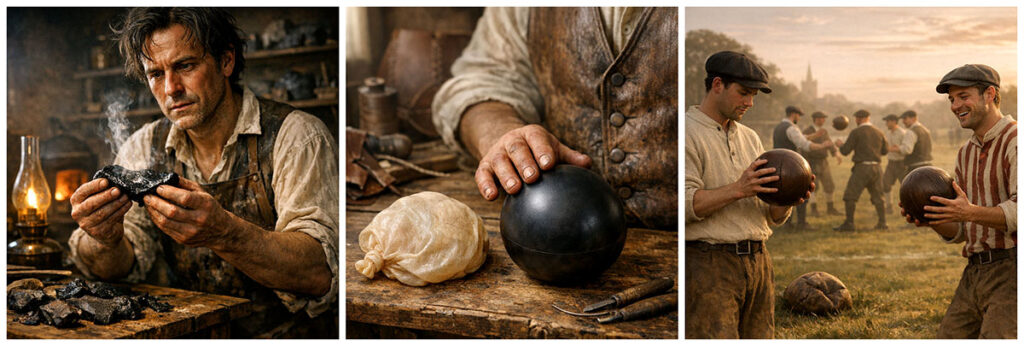
The transition from “animal parts” to “manufactured goods” marks the beginning of the modern Soccer Ball History Timeline.
In the mid-19th century, rubber was known, but it was useless for balls because it turned into sticky goo in the heat and a brittle rock in the cold.
A pivotal moment came from an American inventor with no interest in soccer. Charles Goodyear, after years of failed experiments, discovered the process of vulcanization—heating rubber with sulfur. This created a material that was elastic, durable, and weather-resistant. Charles Goodyear, after years of failed experiments, discovered the process of vulcanization—heating rubber with sulfur. This created a material that was elastic, durable, and weather-resistant. In 1855, he patented and produced the first vulcanized rubber soccer ball.
For the first time, the ball was a perfect, consistent sphere, immune to the quirks of animal anatomy. It was a revelation that a ball stayed round, resisted water, and didn’t rot. And secondly, it also bounced predictably. Therefore, it could be mass-produced. Goodyear’s ball, a dark, solid rubber sphere, was heavy and hard, but it established the principle of standardization. This object is still on display at the National Soccer Hall of Fame.
While Goodyear improved the outside, the inside was still a problem. Most balls still relied on pig bladders. Inflating these bladders was a dirty, dangerous job. You had to blow them up by mouth.
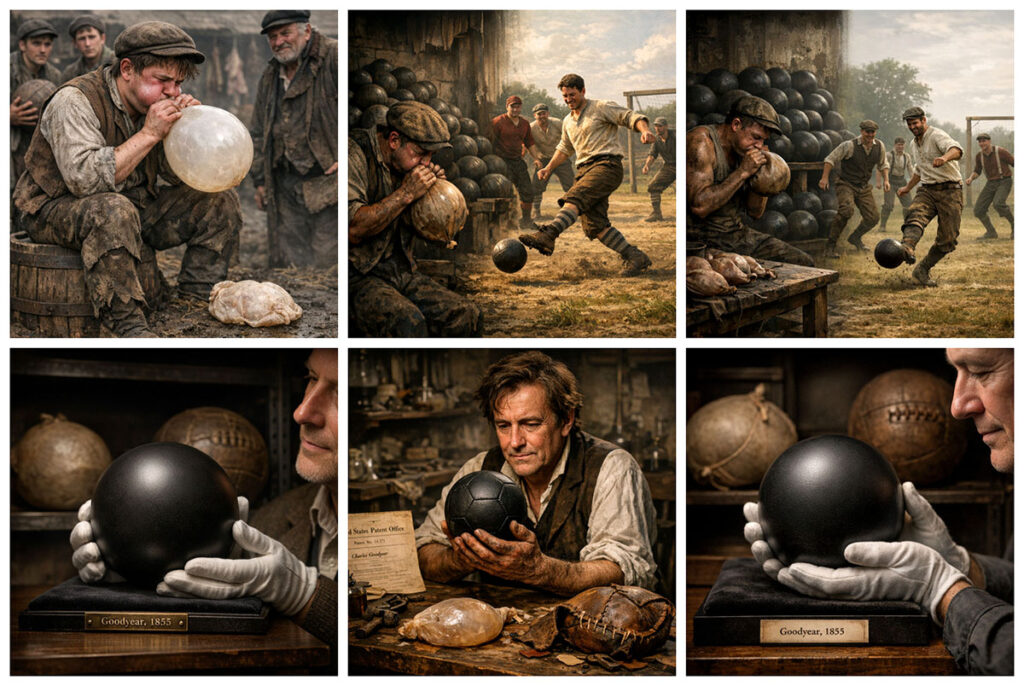
A heartbreaking story soon improved the rubber ball. English leather shoemaker H.J. Lindon was looking for an alternative to the pig’s bladder. Legend holds that his wife died from a lung disease exacerbated by years of inflating bladders. Driven by this personal loss, Lindon invented the first inflatable rubber bladder. This innovation was revolutionary. It was an inflatable rubber lining that could be pumped up with a mechanical pump, saving lungs and creating a perfect sphere.
It could be inserted into a leather casing, was lighter than solid rubber, and allowed players to adjust air pressure. Lindon’s bladder separated the ball’s structure (the leather case) from its pressure system (the inner bladder), a fundamental design principle that still governs ball construction today.

With the formation of FIFA, official laws were introduced. These rules defined ball circumference, weight, and internal pressure. For the first time, players across different countries played with nearly identical equipment.
FIFA laws removed unfair advantages and helped elevate football to a professional sport. Standardization allowed tactics, training, and skills to develop more rapidly.
With rubber bladders and leather casings, consistency was finally achieved. In 1872, the English Football Association set the first specific rules for the Early Soccer Ball Size and Mass.
This step was crucial in transforming football into a truly global game.

The FA Lays Down the Law (1871-1872): As the game codified its rules in London’s Freemasons’ Tavern, the ball’s specifications were finally written into law. The 1872 rules stated: “The ball must be spherical with a circumference of 27 to 28 inches.” Weight was set at 13-15 ounces. This was a monumental act. It meant that a ball made in London had to be identical to one made in Manchester. The sphere was now the law, eliminating the oval bladders of the past and creating a universal standard for competition.
The Birth of an Industry (1888 Onward): The formation of England’s Football League in 1888 created unprecedented demand for consistent, durable balls. Companies like Mitre and Thomlinson’s of Glasgow rose to prominence. They refined the craft: using only the strongest, most uniform leather from a cow’s rump, hand-stitching panels with five-ply hemp, and innovating with interlocking panel designs rather than simple longitudinal strips. The ball was no longer a craft project; it was a product of the Industrial Revolution, setting the stage for its global conquest.
It is a testament to those early pioneers that these dimensions are almost identical to the modern FIFA laws we use today.
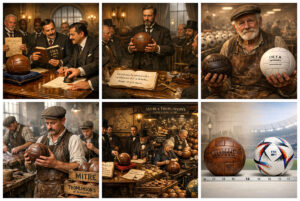
The FIFA World Cup became the testing ground for soccer ball innovation. Early tournaments used simple leather balls, often selected by host nations.
As the tournament grew in importance, manufacturers competed to create better match balls. Each World Cup pushed technology forward, improving balance, visibility, and durability.
World Cup balls became symbols of their era, remembered as much as the goals scored with them.

Early soccer balls were handcrafted items. Leather panels were stitched together by hand around a rubber bladder. The quality of stitching mattered immensely. Poor stitching caused uneven weight distribution and unpredictable flight.
Early soccer ball suppliers became trusted names in the industry. Clubs often preferred specific manufacturers known for durability and balance. There was no mass production—each ball was the result of skilled labor.
This era established the idea that the ball itself could influence the outcome of a match.
As football spread across Britain and Europe, the need for standardization became clear. Balls began to follow general size guidelines, though exact measurements still varied.
During this time, football associations began discussing rules around ball shape and weight. While not perfect, these early standards helped make matches more consistent and competitive.
The 19th century laid the foundation for FIFA laws that would later govern the game worldwide.
The early 1900s introduced the iconic eight-panel leather design. The 1900 eight-panel ball and the 1910 soccer ball became widely used and visually recognizable.
These balls symbolized the classic era of football. However, they still absorbed water, becoming dangerously heavy during rain. Heading the ball required courage, and injuries were a common consequence.
Despite their flaws, these balls played a significant role in shaping legendary playing styles and unforgettable moments.
One historically significant example is the Official FC Barcelona Museum 1899 eight-panel ball. Balls like these are preserved not only as sports equipment but also as cultural artifacts.
They represent the origins of clubs, the birth of rivalries, and the early identity of football communities.
Golden Age of Craft and Flaw
The early 20th-century ball was a masterpiece of artisan craftsmanship, a beautiful yet deeply flawed instrument that directly shaped how the game was played.
Leather and Nightmare Laces: If you look at an Official FC Barcelona Museum 1899 Eight Panel Ball, you will notice it looks like a segmented orange. These balls were made of thick, cowhide leather. Because they still needed to insert the rubber bladder, they couldn’t sew the ball shut completely. They had to leave a slit, which was then laced up with thick leather strings, exactly like a shoe.
Design had severe consequences: The Header Hazard: If you head the ball on the laces, the thick leather knot could slice your forehead open. It was common to see players with scars across their hairlines.
Water Absorption: Leather is a skin; it has pores. In rainy conditions, the 1900 Eight Panel Ball would soak up water. A ball that started at 400g could end the match weighing 800g. Getting hit by that was like taking a punch from a heavyweight boxer.
Inconsistency: Hand-stitching and natural leather meant variations in shape, balance, and bounce. Teams developed preferences, and “home advantage” could include using a ball you were familiar with.
By 1910, Early Soccer Ball Suppliers like Mitre and Thomlinson’s of Glasgow were mass-producing balls. They moved from 8 panels to 12 and 18 strips to try to make the ball rounder. But the quality varied wildly.
The most famous story of this era involves the first-ever FIFA World Cup final in 1930. There was no official match ball.
This flaw reached its dramatic peak in the first World Cup final. Uruguay and Argentina, unable to agree on which ball to use, struck a deal. So the match referee was forced to compromise that the first half would use Argentina’s ball (Tiento), the second half Uruguay’s (T-Model).
Argentina led 2-1 at halftime with their smaller, faster ball. After switching to Uruguay’s larger, heavier model, Uruguay scored three unanswered goals to win 4-2.
Many historians and players of the time believed the change of ball directly altered the match’s momentum and outcome, proving the equipment was as crucial as the athletes.
Change was incremental but vital.
Yet, by the 1962 World Cup in Chile, the core issue remained: leather was a natural material unsuited for all conditions. The search for a synthetic solution was already underway.
The Geometric Shift (1950s – 1960s)
The mid-20th century was about fixing the flaws of the leather era. The biggest breakthrough? Killing the laces. This period saw two parallel revolutions—one in materials, one in design—that fused to create the modern ball.
The Valve Revolution: In the 1950s, a new latex valve was invented that sat flush inside the ball. The laces were gone. The leather was now stitched completely shut, creating a smooth surface for the first time. This revolutionized heading and ball control.
The Buckminster Type Design: Architect Richard Buckminster Fuller was famous for his geodesic domes. Ball manufacturers realized that his design—the Truncated Icosahedron—was the geometric secret to a perfect sphere. By stitching together 20 hexagons and 12 pentagons, they could create a ball that distributed pressure perfectly evenly.
Buckminster Fuller’s “Bucky Ball”: In the 1960s, the American architect solved this structural puzzle. He applied his “geodesic dome” principle to a sphere, demonstrating that a perfectly round, strong surface could be made from a combination of 20 hexagons and 12 pentagons. This pattern distributed stress evenly and eliminated weak points. A Danish company selected this to create a 32-panel ball, but it was a German sportswear giant that would make it iconic.
This was the birth of the “Bucky Ball.” It allowed players to curve the ball (the “Magnus Effect”) more reliably because the airflow was consistent across the surface.
The mid-20th century brought steady improvement. Leather balls received waterproof coatings. Stitching became stronger and more precise. Internal bladders improved air retention.
Players noticed immediate benefits: better control, safer heading, and more reliable performance. Football became faster, more technical, and more strategic.
Adidas Telstar 1970: This is the moment the soccer ball became a celebrity.
For the 1970 World Cup in Mexico, Adidas was tasked with creating the official match ball. They chose the 32-panel Buckminster design. But they did something genius with the paint job.
For the 1970 Mexico World Cup, the first to be broadcast globally via satellite, Adidas faced a problem of how to make the ball visible on millions of black-and-white TV sets. Their solution was the Adidas Telstar. The 1970 World Cup was the first to be broadcast live in color to some, but mostly in black and white to the rest of the world. Adidas used the 32-panel Buckyball design but colored the 12 pentagons jet black and left the 20 hexagons bright white. The high contrast made the ball stand out on the screen. The name “Telstar” paid homage to the satellite enabling the broadcast. Overnight, this black-and-white checkered pattern became the universal symbol for “soccer ball” everywhere from cartoons to traffic signs.
This specific design became the symbol of soccer. Even today, the “save icon” for a generic soccer ball on your computer is a Telstar.
The Synthetic Takeover (1980s – 1990s)
As the game became faster, Soccer Balls in the 20th Century had to evolve. Leather was too heavy and too absorbent.
The Death of Leather
In the 1980s, the Azteca (used in the 1986 World Cup) became the first fully synthetic ball. It was coated in Polyurethane.
Synthetic materials revolutionized soccer balls. These materials resisted water, maintained shape, and allowed precise manufacturing.
Aerodynamic research improved ball flight. Players could bend shots, strike knuckleballs, and control long passes with greater accuracy. The ball became a tool for creativity rather than a limitation.
The Foam Layers (1994): The Questra ball used in the 1994 USA World Cup introduced layers of polystyrene foam (like Styrofoam bubbles) under the skin. This made the ball feel soft to the touch (cushioning) but explode off the foot with incredible speed. It was a nightmare for goalkeepers but a dream for strikers.
2006 (Teamgeist): A radical leap. Only 14 panels, thermally bonded together (not stitched) for the first time, creating a perfectly round, seamless surface.
The Aerodynamic Age (2000s – Present)
In the modern era, the latest developments have moved from chemistry to aerospace engineering.
Modern soccer balls are engineered using advanced materials and computer modeling. Thermally bonded panels eliminate stitching errors. Surface textures improve grip and flight stability.
Some balls now include smart technology, providing real-time data on speed, spin, and trajectory. These innovations support referees, coaches, and players alike.
As engineering advanced, a new challenge emerged: could a ball be too predictable? Adidas’s 2010 Jabulani, with its 8 glued panels and ultra-smooth surface, was a notorious example.
The quest for perfection hit a snag in 2010 with the infamous Jabulani. It had only 8 panels and was too round. In fluid dynamics, you actually need some roughness (seams) to stabilize flight (like dimples on a golf ball). Without enough seams, the Jabulani experienced a “drag crisis” at high speeds, causing it to “knuckle” (wobble) unpredictably. Goalkeepers and strikers alike vilified it, calling it a “beach ball” and a “supermarket ball” for its erratic, knuckling flight in thin air. It is widely considered the most hated ball in goalkeeping history. It was a lesson that physics and player feel had to be balanced.
Learning from the Jabulani, subsequent balls like the Brazuca 2014 (with longer, deeper seams for stability), the 2018 Telstar (with a textured gripper surface), and Al Rihla (2022) incorporated deep grooves and textured skins. These features controlled the airflow, ensuring the ball went exactly where the player kicked it.
Every era of soccer ball history solved problems from the previous one. From shape and weight to aerodynamics and durability, each step improved the game’s fairness and excitement.
Key Milestones
The development of the soccer ball can be divided into several notable phases, each marked by important advances in materials and construction techniques.
The evolution of the soccer ball mirrors the sport’s evolution. From its beginnings as a discordant pastime to its standing as a worldwide phenomenon, the ball has been central to how the game evolved. Early balls were emblems of ingenuity and imagination, while their modern-day counterparts reflect the uppermost of technical prowess.
Soccer had become a sport, but it wasn’t until the late 19th century that standards were set for the balls used in the same, and that was only due to growing organizations like the FA and FIFA. The soccer ball has undergone a remarkable journey over the past few decades, from a simple piece of equipment to an iconic emblem that transcends borders, reflects cultural diversity, and embodies the spirit of the beautiful game.
One of the key institutions responsible for this is FIFA, the sport’s international governing body, which has played a significant role in standardizing balls. FIFA formalized its specifications for ball size, weight, and performance from the twentieth century onward. The size of the ball will vary depending on how it is played, but for example, a Size 5 ball used in professional matches must have a circumference of 68–70 cm and weigh between 410–450 grams. Some references include standardized regulations and rules of the game to help enforce consistency across competitions and levels of play.
Soccer balls today are designed to maximize performance. Key features include:
Aerodynamic Panels: Designed to reduce air resistance and improve flight stability.
Thermal Bonding: Replaces traditional stitching, creating a smoother surface for better control.
Water-Resistant Coatings: Prevent water absorption, ensuring consistent performance in wet conditions.
For players and enthusiasts, selecting the right soccer ball depends on factors like age, skill level, and playing surface.
Indoor vs. Outdoor Balls: Indoor balls are designed for hard surfaces, while outdoor balls are built to withstand grass and turf.
With the rise of synthetic materials, the environmental impact of soccer ball production has become a concern. Some manufacturers are now exploring sustainable alternatives, such as recycled materials and eco-friendly production processes. As consumers, choosing environmentally responsible products can help reduce the sport’s carbon footprint.
Innovative technology is the future of soccer balls. Companies are testing onboard with embedded sensors to monitor performance metrics such as speed, spin, and trajectory. This technology could transform training and gameplay, offering players and coaches immediate feedback to improve performance.
Trends and Developments
The future of soccer balls focuses on sustainability, precision, and data integration. Eco-friendly materials are becoming more common. Smart sensors may soon be standard in professional matches.
While the look of the ball may remain familiar, its technology will continue to evolve.
We are now entering the age of the “Smart Ball.”
The Connected Ball: History of the World Cup Official Match Balls reached a sci-fi peak in 2022. The ball contained a suspension system holding an Inertial Measurement Unit (IMU) sensor.
Sustainability
While we celebrate the soccer ball’s origins, we also anticipate its future. As materials science and design evolve, the soccer ball will continue to grow, challenging performance limits and enriching the beautiful game for generations.
The next frontier is the planet. Manufacturers are currently prototyping balls made from bio-based materials (sugar cane fibers) and water-based inks to reduce the reliance on plastic, ensuring the beautiful game keeps the planet beautiful too.
Advice
The history of the soccer ball is a story of innovation driven by real needs. Every improvement made the game safer, fairer, and more enjoyable. From animal bladders to high-tech match balls, the soccer ball has evolved alongside the sport itself. Understanding this journey deepens our appreciation for every kick, pass, and goal.
When you look at the Soccer Ball History Timeline, you realize that the ball is more than just rubber and air. It is a chronicle of human progress. We went from the brutality of the Middle Ages—kicking pig organs and risking infection—to the rubber revolution of the 1800s, and finally to the aerodynamically perfect, micro-chipped spheres of today.
Every time you see a ball ripple the back of the net, remember the centuries of innovation that made that flight possible. From the 1900 Eight Panel Ball to the high-tech missiles of the FIFA World Cup, the goal has always been the same: to keep the game rolling.
In the early 1900s, using 18 long strips of leather was the best way manufacturers knew to approximate a sphere. However, these strips often elongate over time, making the ball egg-shaped. The move to the 32-panel hexagon/pentagon design in the 1960s solved this structural issue.
The Tiento was the ball chosen by Argentina for the 1930 World Cup Final. It was slightly smaller and lighter than its counterpart, the Uruguayan “T-Model.” Argentina led the match while using the Tiento, highlighting how significant ball specifications were in Early Soccer Ball History.
Before 1872, the size of the ball depended on the size of the pig bladder available. The 1872 rules standardized the size (27-28 inches) and weight. This allowed players to develop consistent skills and tactics, as they finally knew how the ball would react from match to match.
Modern thermally bonded balls are so smooth that they would fly unpredictably (knuckleball) without texture. The bumps and grooves (macro and micro-textures) disturb the air slightly, creating a boundary layer of turbulence that stabilizes the ball’s flight path, much like the dimples on a golf ball.
While balls were used in previous tournaments, the Adidas Telstar (1970) is considered the first “Official World Cup Match Ball” commissioned by FIFA to be used exclusively in the tournament, starting the tradition of naming a new ball for every World Cup.
Modern soccer was officially codified in 1863 when the Football Association (FA) in England established the first set of unified rules. However, the game’s roots trace back over 2,000 years to ancient China’s Cuju, as well as various “mob football” games played in Medieval Europe.
While standardized balls were never made this way, dark legends from Viking and Medieval English history suggest that the severed heads of enemies were occasionally kicked as a celebratory act of war. This macabre folklore preceded the use of more “civilized” materials like pig bladders.
Early players wore heavy knickerbockers or long trousers, thick wool shirts, and caps. Instead of modern cleats, they wore rigid, ankle-high leather work boots, often reinforced with steel toes and leather strips on the soles for traction.
The first manufactured balls were dark brown, heavy, and somewhat lopsided. They consisted of 8 to 18 leather panels stitched together with thick, protruding laces on one side, which were used to seal the internal bladder.
Charles Goodyear is credited with inventing the first vulcanized rubber soccer ball in 1855. This breakthrough replaced the unpredictable pig bladder with a durable rubber sphere that maintained its shape in different weather conditions.
No single person invented the ball; it is one of humanity’s oldest inventions. Ancient Egyptians, Greeks, and Chinese cultures all created variations of balls using linen, animal hair, or reeds for sports and training thousands of years ago.
Old balls had laces to close the leather “pocket” after the internal rubber bladder was inserted. Before the invention of the modern air valve in the 1950s, the only way to inflate and seal a ball was to pull the bladder neck through a slit and lace it up tightly.
This design, known as a Buckminster Type or truncated icosahedron, is the geometric secret to a perfect sphere. Combining 20 hexagons and 12 pentagons allows flat panels to curve evenly, creating a ball that is aerodynamically stable and perfectly round.
The first soccer balls were not invented by a single person. Early versions were made by ancient civilizations using animal bladders. Modern soccer balls began evolving in England during the 19th century as football rules became formalized.
Early soccer balls were made from pig or cow bladders wrapped in leather. These materials made the balls uneven in shape and difficult to control during matches.
Leather soccer balls started disappearing in the late 20th century when synthetic materials became widely available. Synthetic balls performed better in wet conditions and improved player safety.
Old soccer balls absorbed water because leather is porous. As matches continued, the ball became heavier, making kicking and heading more difficult.
Some of the oldest known soccer balls date back to the early 1800s. These historic balls are now preserved in football museums and private collections.
FIFA began standardizing soccer ball size, weight, and pressure in the early 1900s. This helped ensure fair and consistent play across international competitions.
Laces were used to close the leather panels after inserting the bladder. While functional, they caused discomfort and injury during heading.
The eight-panel soccer ball was a common early design used in the early 1900s. It helped improve balance and shape compared to earlier ball designs.
Vulcanization strengthened rubber bladders and allowed them to hold air consistently. This innovation greatly improved durability and ball shape.
The first official World Cup match balls appeared during the 1930 FIFA World Cup. They played a major role in standardizing football equipment worldwide.
Synthetic materials reduced water absorption and improved durability. They also allowed better control, consistency, and safer gameplay.
Modern soccer balls use advanced synthetic layers and precision bonding. They are lighter, more durable, and aerodynamically stable.
Modern panel designs and surface textures improve airflow around the ball. This allows for better accuracy, curve, and shot control.
Yes, modern soccer balls are designed to reduce injury risk. They are lighter, evenly balanced, and safer for heading.
Today’s soccer balls use synthetic leather, polyurethane layers, and latex or butyl bladders. These materials improve durability and performance.
Each World Cup introduces new ball technology and materials. Many of these innovations later became standard in professional football.
Yes, all professional and match-approved soccer balls must meet FIFA regulations. These rules cover size, weight, and internal pressure.
Yes, some modern soccer balls include sensors to track speed and movement. They are used for training analysis and goal-line technology.
Soccer ball history shows how technology shaped the modern game. Each improvement helped make football safer, fairer, and more enjoyable.
Future soccer balls will focus on sustainability and smart technology. Manufacturers are developing eco-friendly materials and data-driven designs.